
Food Materials Engineering
We aim to understand the functional properties of complex multi-component, multi-phase and multi-scale structured food materials, in relation to their origin, structure and composition and processing history, and use this to create new and healthy food materials that have lower environmental footprint.
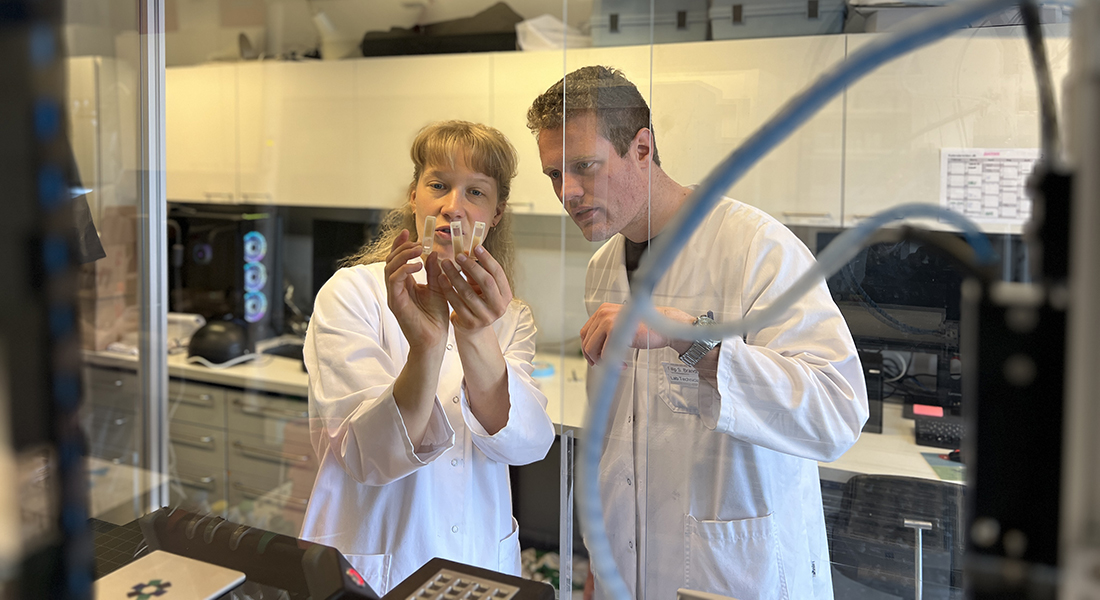
Foods are wonderfully complex materials. Not only do they consist of many different components, but these are also arranged in a structure that spans many different sizes: from molecular and colloidal, all the way up to the sizes that we can see an experience during preparation and consumption.
The properties of foods follow not just from their composition, but perhaps even more strongly, on this multiscale structure. We aim to understand how properties of a food emerge from the complexity in this multiscale structure. The properties we investigate are mainly physicochemical in nature, such as the development of structural heterogeneity during processing, stability and dynamics of a product’s internal structure, during processing and preparation, ingestion and digestion.
- We investigate the multiscale structure of food materials, in the original raw materials, during conversion of these raw materials into food ingredients, and during structuring of these ingredients into formulated foods that we enjoy eating.
- We explore the potential of retaining some of the structure of raw materials in ingredients, as this can reduce the number of additives needed to create stable foods, and significantly reduce the overall environmental impact of foods.
- We also explore the combination of different food materials to create new food materials, to extend the technical functional and digestive properties that we can achieve.
- We capture the relation between the structural complexity and the properties of foods, we use data-driven modelling of the functionalities of food ingredients when used in formulated foods, as function of their origins, processing histories and structural characeristics.
- To have sufficient experimental data for data-driven modelling, we develop new, scalable experimental methods to quantify the technical and digestive functionalities as function of the origins and processing history.
- Scalable rapid experimentation methods to quantify technical and digestive properties of food ingredients and formulated foods. This includes rheometric characterization, structuring and stability of disperse systems (emulsions, foams, biopolymeric materials)
- Analytical infrastructure, shared with other groups (HPLC/UPLC, LCMS/MS)
- Microscopic analysis (fluorescence microscopy, including time-resolved fluorescence), shared with other groups
- Rheology (standard rheometry, diffusive wave spectroscopy and microspectroscopy, scalable rapid experimentation)
- Mechanistic and date driven modelling for data extraction and quantification of functionality
AI4NaturalFood: Naturally Smart: Sustainable Food using Artificial Intelligence
RECRUIT grant. PI: Prof. Remko Boom: Funding agency: Novo Nordisk Foundation (NNF). Jan 2025-Dec 2031.
Direct use of the native structure of plant raw materials for our foods can provide large savings of greenhouse gas emissions and water, while doubling the final amount of food produced. It also enables a diet with more natural fibre without having to use additives.
Currently, plant ingredients are refined to almost molecular purity - and then combined again to create structured foods. This isolation is resource intensive, and the removal of fibre and micronutrients compromises the nutritional value. The original structure in plant seeds resembles the structure of foods; so why not retain the structures that nature already provides? Retaining these native structures however makes formulation of foods very complex, as many mechanisms interact at the same time. To enable mild processing of natural ingredients whilst directly using the plant’s native structures, we model these complex interactions using data-driven approaches with a sufficiently expressive class of models.
Finded by the Novo Nordisk Foundation, the project is a unique collaboration between KU’s FOOD Department and the Computer Science (DIKU) department. The FOOD department develops new methods for generating sufficient experimetal data on physicochemical and digestive functionalities, which are then used at DIKU to build physics-informed models that can be used to optimise the formulations on sustainability indicators.
Read more about AI4NaturalFoods
Acetate consortium, Phase 2
Co-PI: Prof. Remko Boom: Funding agency: Novo Nordisk Foundation (NNF). Aug 2025-June 2027.
Imagine if we were able to turn one of our biggest environmental challenges – CO₂ – into nutritious food. The idea is not as far out as it may sound: funded by the Gates Foundation and the Novo Nordisk Foundation, the Acetate-to-Food Consortium translates the principles that have been shown in the last two years, towards production of optimal food ingredients and foods.
The goal is to mitigate food insecurity and climate change as well as eliminating land use for food production. The principle behind is based on natural processes that can be scaled into financially viable production of nutritious food without using agricultural land. Our role in this is to characterize the technical and digestive functional properties of the ingredients, as function of their processing history, structure and composition, to optimize processing and formulation of structured foods with excellent taste and minimal footprint.
Group members
| Name | Title | Phone | |
|---|---|---|---|
| Adar Fridman | PhD Fellow | +4535325498 | |
| Koen Wetterauw | Postdoc | +4535324571 | |
| Rasmus Stampe Skovgaard | Laboratory Technician | +4535329784 | |
| Remko Marcel Boom | Professor | +4535337769 | |
| Tjalling Gijsbert Tjalsma | Postdoc | +4535321058 | |
| Tobias Roland Dons | Postdoc | +4535323855 |
Contact the research group leader
Remko Marcel Boom
Professor in Food materials Engineering
UCPH FOOD section: Ingredient and Dairy Technology